 Waiting List Registration
 Book A Tour
33 Mallard Rd: (647) 478-6114
141 Bond Ave: (647) 478-6043
25 Mallard Rd: (647) 812-7795
33 Mallard Rd: (647) 478-6114
141 Bond Ave: (647) 478-6043
25 Mallard Rd: (647) 812-7795
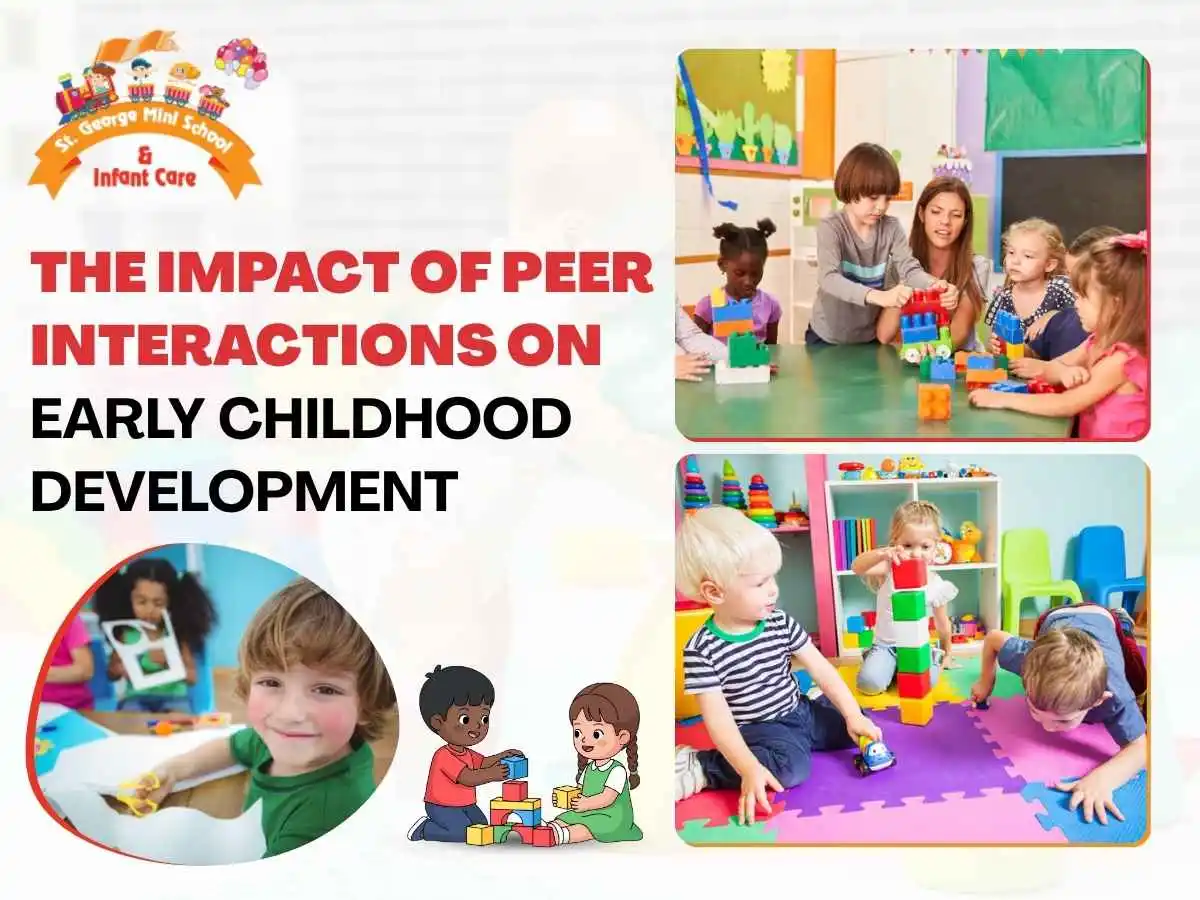
2026-06-11
Ask a parent what they want their child to gain
from daycare, and you'll hear a fairly consistent list. Safety. Stimulation. A
good routine. Maybe some early exposure to letters and numbers.
What rarely makes that first list — but arguably
matters most — is this: other children.
The relationships young children form with their
peers are not a side effect of being in a group care setting. They are one of
the most powerful engines of development available to a child in the early
years. At a quality day care center, every shared snack, every negotiated turn,
every moment of parallel play beside another small human is quietly building
something that no worksheet or lesson plan can replicate.
At St. George Mini School in North York, we
understand that the child sitting beside yours may be one of the most important
educators your child will ever have.
What Children Learn From Each Other That Adults
Cannot Teach
There are things a child simply cannot learn from
an adult — no matter how skilled, warm, or experienced that adult is.
Adults instinctively adjust. They simplify
language, yield in disagreements, regulate the pace of interaction, and soften
feedback. This is natural and often appropriate — but it means a child in
adult-only interactions is always operating with a kind of invisible safety
net. Peers don't offer that net.
When a four-year-old interacts with another
four-year-old, they encounter a genuine equal - someone with the same limited
emotional vocabulary, the same developing impulse control, the same competing
needs and wants. Navigating that relationship requires real skill. And the only
way to build those skills is to practice them, imperfectly and repeatedly, in
real time.
This is what happens every day inside a well-run
daycare or day care school. Children are constantly practicing — communicating,
misreading, repairing, adjusting, trying again.
The Developmental Domains Peer Interaction Builds
The impact of peer relationships in early childhood
isn't confined to one area of development. It ripples across nearly every
domain.
Social Development: Children learn the fundamental rules of human
interaction through peers: how to enter a group, how to maintain a friendship,
how to repair one after conflict. These are not abstract concepts. They're
lived, repeated experiences that wire social understanding into the developing
brain.
Emotional Development: Interacting with peers is one of the earliest
and most effective schools for emotional regulation. A child who wants a toy
that another child is holding has to control their frustration, practice the
ability to wait for something they want, and find a way to politely express
their wants. Repeated thousands of times across the daycare years, these
moments build genuine emotional resilience.
Language and Communication: Research consistently shows that peer
interaction drives language development in ways adult interaction alone does
not. Children stretch their vocabulary, practice conversational turn-taking,
learn to read non-verbal cues, and discover the power of words as tools for
connection and influence — all through talking with each other.
Cognitive Development: Abilities Cooperative games like constructing
something collaboratively, making up games where there are rules that both
agree on, or tackling an issue as a team require more advanced types of thought
than do individual games. Kids will disagree with their peers' thoughts,
suggest new ideas, and consider things from many angles at once.
Empathy and Perspective: Taking One of the most important capacities
a human being can develop is the ability to understand that other people have
inner lives, feelings, and experiences different from their own. Psychologists
call this theory of mind, and it develops most robustly through peer
interaction in the early childhood years.
Why the Day Care Environment Is Uniquely Positioned
to Support This
Peer learning doesn't happen automatically just
because children are in the same room. The environment, the structure, and —
most critically — the educators make all the difference.
At a quality child care in north york setting,
skilled caregivers do something that looks deceptively simple: they create the
conditions for meaningful peer interaction, then step back far enough to let it
happen.
This means designing spaces that invite
collaboration rather than isolation. It means allowing conflict to reach a natural
resolution before intervening. It means narrating social dynamics in real time
— "It looks like Marcus wanted a turn — how could you let him know?"
— rather than simply managing behaviour from the outside.
At St. George Mini School, our educators are
trained in exactly this kind of facilitation. We don't just supervise peer
interaction at our day care center in North York. We treat it as a core part of
the curriculum — because developmentally, it is.
Mixed-Age Groupings: Where Peer Learning Goes Deeper
One of the most underappreciated dynamics in early
childhood care is what happens when children of different ages share a space.
When a five-year-old helps a three-year-old with a
puzzle, both children grow. The younger child gains a patient, relatable guide.
The older child consolidates their own understanding, practises leadership, and
develops the kind of gentle confidence that comes from being genuinely helpful.
This is not accidental at quality day care schools.
It's intentional design — rooted in decades of research on the developmental
benefits of mixed-age peer relationships.
The Friendships That Shape Who They Become
The child your son builds a block tower with today.
The girl your daughter chases around the yard on a Wednesday morning. The quiet
child who sits beside yours at lunch and slowly, over weeks, becomes a friend.
These connections feel small in the moment. However,
it has been clearly established that peer relationships at an early age will
determine future success in social adjustment, emotional happiness, as well as
academic participation.
The day care years are not a waiting room before
real life begins. They are real life — full of real relationships that
genuinely matter.
Give Your Child a Place Where Peer Learning Thrives
At St. George Mini School, we've built a Day Care Center in North York where
peer interaction is valued, facilitated, and celebrated every single day.
Because we believe the children in the room are
part of what makes the room extraordinary.
Featured Blogs
 28/03/22
Which Is The Best Age To Start Chil...
Daycare North York Infant Daycare North York Day Care Center North York Subsidized Daycare North York Daycare Toddlers North York Preschool Programs North York Child Care North York Before and After School Care North York Day Care North York Preschool North York Subsidized Child Care North York Day Care Schools North York



33 Mallard Rd. Centre
- Contact: Sarah Ashfield
- Tel: (647) 478-6114
- E-mail: [email protected]
- 33 Mallard Rd., North York, Ontario M3B 1S4
25 Mallard Rd. Centre
- Contact: Rasha Shamas, RECE
- Tel: (647) 812-7795
- E-mail: [email protected]
- 25 Mallard Rd., North York, Ontario M3B 1S4
141 Bond Ave. Centre
- Contact: Jenna Wright, RECE
- Tel: (647) 478-6043
- E-mail: [email protected]
- 141 Bond Ave., North York, Ontario M3B 1M1
All Rights Reserved © 2026-2027. St. George Mini School & Infant Care.