 Waiting List Registration
 Book A Tour
33 Mallard Rd: (647) 478-6114
141 Bond Ave: (647) 478-6043
25 Mallard Rd: (647) 812-7795
33 Mallard Rd: (647) 478-6114
141 Bond Ave: (647) 478-6043
25 Mallard Rd: (647) 812-7795
2026-06-23
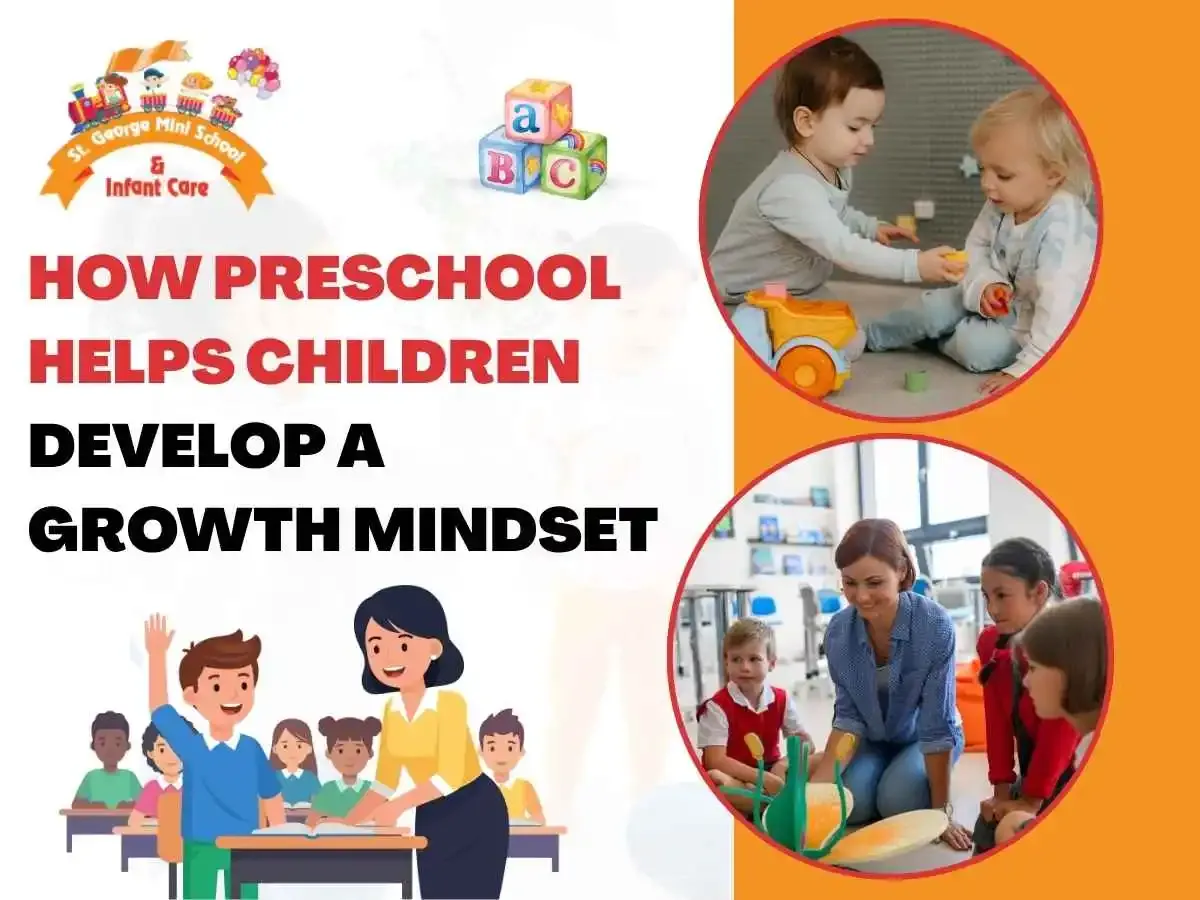
There is a moment most early childhood educators know well. A child is working on something — a puzzle, a drawing, a block structure — and it doesn't go the way they planned. The tower falls. The line goes crooked. The pieces won't fit.
What happens next tells you
everything
One child pushes it away in frustration and declares, "I can't do
it." Another pauses, looks at what happened, and tries a different way.
Same age. Same activity. Completely different internal response.
That difference has a name. Psychologist Carol Dweck, whose decades of
research at Stanford changed how educators around the world think about
learning, calls it mindset. Children who believe their abilities are fixed —
who think they either have it or they don't — operate from a fixed mindset.
Children who believe effort leads to growth operate from a growth mindset. And
the implications of that difference follow a child for the rest of their life.
What most parents don't realize is that the foundation for a growth
mindset is laid far earlier than primary school. It begins in the daily,
ordinary moments of a quality preschool — in how a caregiver responds to a
mistake, how a challenge is framed, and whether a child's effort is seen and
valued more than their outcome. For families exploring Preschool North York
options, understanding this distinction is one of the most important things
they can do before choosing a program.
Why the Preschool Years Are the
Critical Window
The early childhood years are not just important for growth mindset
development — they are the most important window.
Between ages two and six, children are building their foundational beliefs
about themselves as learners. Am I capable? Is trying worth it? What happens
when I fail — is that the end, or just information? These beliefs, once formed,
are remarkably durable. A child who arrives at kindergarten already believing
that effort matters and mistakes are part of learning has a head start that no
amount of academic catch-up can fully replicate.
This is not about pressure or performance. It is about the quiet,
consistent messages a child receives in their earliest learning environment —
messages that accumulate into a worldview.
The best preschool programs in North York are built around exactly this
understanding. Every routine, every activity, every educator response is shaped
by an awareness that what a child believes about themselves as a learner is
being formed right now — and that belief matters enormously.
What Growth Mindset Actually Looks
Like in a Preschool Classroom
Growth mindset isn't a curriculum. It's a culture — and it's built through
the small, everyday
interactions that take place throughout the preschool day.
The language educators use. There is a
world of difference between "Good job!" and "I noticed how hard
you worked on that." The first praises the outcome. The second praises the
process — the effort, the persistence, the strategy. Research consistently
shows that process praise builds genuine resilience, while outcome praise
quietly teaches children that their worth depends on getting it right.
Skilled educators at quality child care programs understand this
distinction and apply it constantly, often without the child even noticing.
How mistakes are handled: In a growth
mindset environment, a mistake is never a verdict. It's a data point. When a
child's structure falls, a thoughtful caregiver doesn't rush to fix it or offer
reassurance that it was fine. They ask: "What do you think happened? What
could we try differently?"This simple reframing teaches children that
failure is not something to run away from at all costs; it is something to be
curious about.
The activities offered: Day care
centers that support growth mindset design activities that are deliberately
open-ended — with no single right answer, no perfect outcome, and room for
individual interpretation. Building, creating, experimenting, storytelling —
these activities invite children to engage with genuine uncertainty, which is
exactly where growth mindset is exercised and strengthened.
The way persistence is modelled: Children
learn from watching. When an educator sits beside a child and says, "This
is tricky for me too — let me think about how to approach it," they are
modelling something invaluable: that capable, trusted people also struggle, also
try, and also keep going.
The Role of Healthy Challenge in
Building Confident Learners
One of the most counterintuitive insights from growth mindset research is
this: children who are never allowed to struggle don't become more confident.
They become more fragile.
When every obstacle is removed, every frustration smoothed over, every
challenge made easier — a child never discovers what they're actually capable
of. They never experience the specific satisfaction of working through
something hard and coming out the other side.
Quality day care programs understand that the goal is not to make every
moment easy. It is to make every moment feel safe enough to try. There's an
enormous difference between the two.
This philosophy doesn't stop when the preschool day ends. The best Before
and After School Care North Yorkprograms extend this same growth mindset
culture into the afternoon hours, ensuring that the resilience built in the
morning isn't quietly undone by an environment that expects perfection.
A child who has experienced appropriate challenge — who has sat with the
discomfort of not knowing, tried anyway, and eventually figured it out —
carries a quiet confidence that no amount of reassurance can manufacture.
That knowledge is one of the greatest gifts an early childhood program can
give.
From "I Can't" to
"I Can't Yet"
The word yet is small. But in the hands of a skilled early childhood educator, it is transformative.
"I can't do it" is a closed door. "I can't do it yet"
is an open one — an acknowledgement that the story isn't finished, that effort
still has somewhere to go, that today's struggle is tomorrow's capability.
Teaching children to add yet to their self-talk is one of the simplest and
most effective things a day care center can do to build a growth mindset. And
in a program where this language is modelled consistently by every educator,
every day, it becomes the child's own internal voice — one they carry with them
long after they've left the classroom.
About St. George Mini School
St. George Mini School is a licensed child care provider in North York,
offering infant care, toddler programs, Preschool Programs in North
York, day care, and before and after-school care services for children
through the primary years. Our educators are trained to nurture every child's
curiosity, resilience, and belief in their own potential — building the growth
mindset that makes lifelong learning not just possible, but joyful.
Featured Blogs
 28/03/22
Which Is The Best Age To Start Chil...
Daycare North York Infant Daycare North York Day Care Center North York Subsidized Daycare North York Daycare Toddlers North York Preschool Programs North York Child Care North York Before and After School Care North York Day Care North York Preschool North York Subsidized Child Care North York Day Care Schools North York




33 Mallard Rd. Centre
- Contact: Sarah Ashfield
- Tel: (647) 478-6114
- E-mail: [email protected]
- 33 Mallard Rd., North York, Ontario M3B 1S4
25 Mallard Rd. Centre
- Contact: Rasha Shamas, RECE
- Tel: (647) 812-7795
- E-mail: [email protected]
- 25 Mallard Rd., North York, Ontario M3B 1S4
141 Bond Ave. Centre
- Contact: Jenna Wright, RECE
- Tel: (647) 478-6043
- E-mail: [email protected]
- 141 Bond Ave., North York, Ontario M3B 1M1
All Rights Reserved © 2026-2027. St. George Mini School & Infant Care.