 Waiting List Registration
 Book A Tour
33 Mallard Rd: (647) 478-6114
141 Bond Ave: (647) 478-6043
25 Mallard Rd: (647) 812-7795
33 Mallard Rd: (647) 478-6114
141 Bond Ave: (647) 478-6043
25 Mallard Rd: (647) 812-7795
2026-08-25
Walk
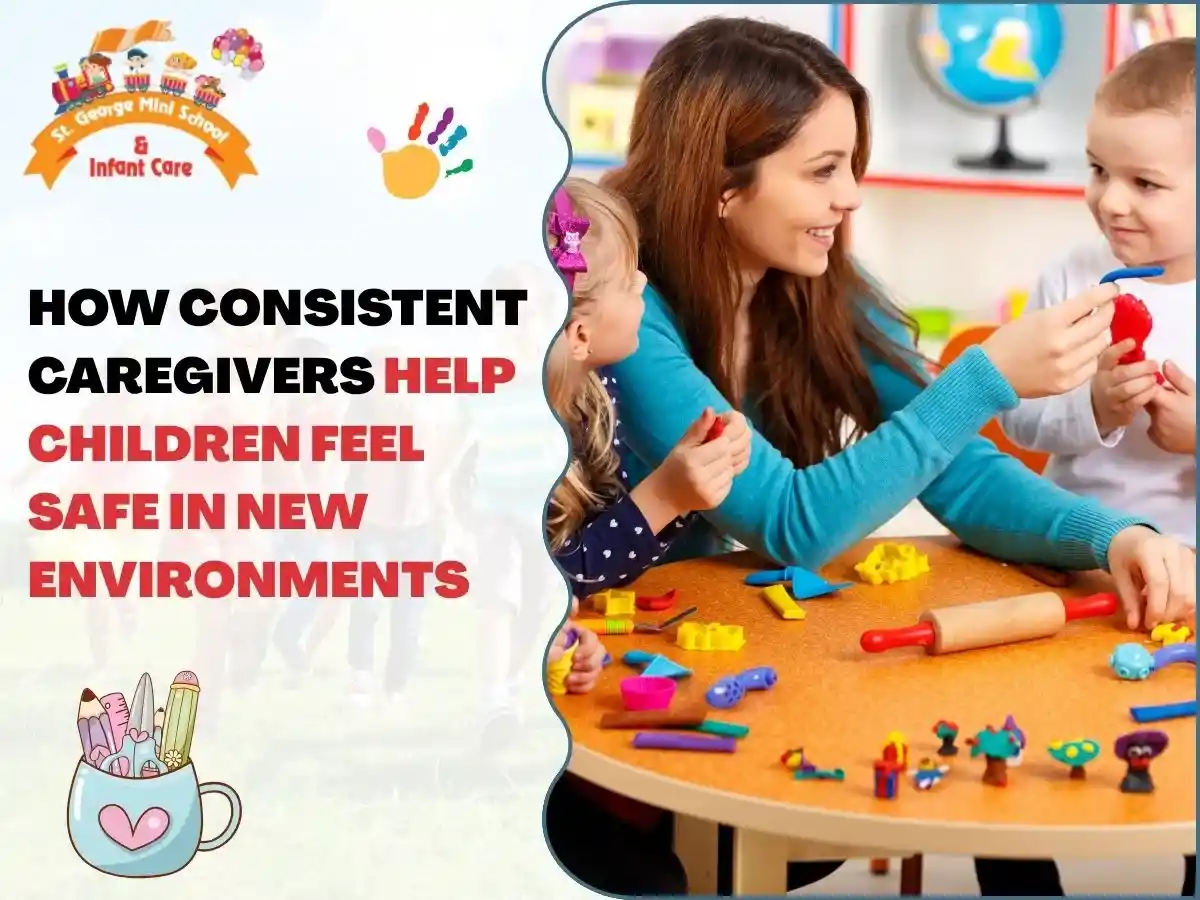
into most infant rooms and you'll notice something within the first five
minutes: which educator a particular baby turns toward when something goes
wrong. Not whoever's closest. Not whoever's loudest. A specific person. That's
not a coincidence, and it's not something a good room leaves to chance — it's
the result of a deliberate approach to staffing that has more research behind
it than almost anything else in early childhood care.
What "Consistent Caregiver"
Actually Means
In
practice, this shows up as one of two related models. The first is called primary caregiving — one educator takes
lead responsibility for a small group of three or four children within a larger
classroom, handling most of their feeding, diapering, comforting, and daily
check-ins, rather than tasks being split evenly across whoever's on shift. The
second is continuity of care, where
a child keeps the same educator (or small team) as they move through infancy
and toddlerhood, sometimes for two to three years, instead of switching to a
new set of adults every time they age into the next room.
Neither
means a child only ever interacts with one adult — that's neither realistic nor
healthy. It means one relationship anchors the day, and everything else builds
around it.
Why This Isn't Just a "Nice to
Have" — It's Attachment Theory in Practice
The
reasoning here goes back to attachment research from Bowlby and Ainsworth, work
that's been built on for decades since: children develop a sense of security
through a stable, responsive relationship with a caregiver, and that security
is what lets them go explore the world confidently rather than staying anxious
and guarded. A child with a secure base doesn't need to spend their energy
monitoring whether they're safe — that question's already settled, so the
energy goes into playing, learning, and interacting with peers instead.
This
isn't specific to parents. Research on child care settings has found that
infants and toddlers who receive stable, responsive, consistent care from a
primary caregiver form similarly secure attachments to that person — and that
those attachments matter for the same reasons a secure parent attachment does.
One tracked study found that the longer an infant or toddler stayed with the
same provider, the more likely a secure attachment was to form, with the
strongest results showing up after roughly a year together.
The
flip side has been studied too, and it's fairly stark: children who go through
repeated caregiver changes before age two tend to show less secure attachment
and more aggressive behaviour compared to children who had one consistent
caregiver over that period. That's not a minor statistical footnote — it's part
of why organizations like NAEYC (the National Association for the Education of
Young Children) treat continuity of care as a marker of program quality, not an
optional extra.
What Happens Without It
Picture
a toddler room where the adults rotate through on a shift schedule with no
fixed assignment — whoever's on the floor that hour handles whoever needs
something. Functionally, the room still "works." Diapers get changed,
meals get served, nobody's neglected in any obvious sense.
But
something's missing underneath that. No single adult is building the kind of
deep, specific knowledge of a child that lets them tell the difference between
a cry that means "hungry" and a cry that means
"overwhelmed." No one's tracking that this particular child gets
clingy after a weekend away, or needs ten minutes alone before joining group
play, or is teething and off their usual rhythm. That knowledge doesn't come
from a shift log. It comes from time spent with one child, repeatedly, by the
same person.
Frequent
turnover compounds this. Every time a child's primary educator leaves — and
turnover is a real, persistent challenge across the child care sector — a child
effectively has to rebuild the sense of safety they'd developed, from close to
zero. A centre that can't hold onto staff isn't just dealing with an HR
problem; it's quietly resetting attachment security for every child in that
room, over and over.
What Consistency Actually Looks Like Day to
Day
It's
less dramatic than it sounds. A consistent caregiving model, done well, looks
like:
The
same educator handling a given child's arrival most mornings, so drop-off has a
familiar face attached to it rather than whoever happens to be free. The same
person doing the bulk of that child's feeding, sleep routine, and diapering —
not because other educators can't, but because doing it consistently is what
builds the relationship. A primary educator who's also the main point of
contact for that family, so parents aren't getting a different, less-informed
update from a different person every day. And when a child does age up to a new
room, some kind of transition period — visits to the new space, a familiar face
for the first few days — rather than an abrupt handoff.
None
of this requires a child to be shielded from other adults. Kids in a well-run
room still interact with the whole team. The difference is that one
relationship is deliberately built to be deeper than the rest, and everyone in
the room knows which one that is.
What to Ask When You're Touring a Day Care in
North York
This
is a genuinely useful filter question, and most parents don't think to ask it
directly: do you assign a primary educator to each child, and how do you handle
it when that educator is away or leaves?
A few
follow-ups worth asking:
How
long do educators typically stay in this classroom? A year of turnover doesn't
necessarily mean a bad program, but persistent, high turnover is worth taking
seriously.
What
happens when my child moves up to the next age group — do they know anyone in
that room already?
If my
child's primary educator is on vacation or sick, who steps in, and how familiar
are they with my child already?
A
centre with a real answer to these — specific names, specific practices — is
telling you something concrete about how the room actually runs. A vague
"we're all really close with the kids" answer might still be true,
but it's not the same thing as a structured approach to continuity.
Mistakes That Undermine Consistency — Even
With Good Intentions
Treating every educator as interchangeable. Cross-training staff to cover multiple rooms
is often necessary operationally, but if it means no child has a clear
"person," something gets lost.
No transition plan between rooms. Aging up from toddler to preschool is a
significant shift for a child. Doing it without any overlap or familiar face
makes it harder than it needs to be.
Ignoring the parent side of the relationship. Continuity isn't just child-to-educator.
Parents build trust with a consistent point of contact too, and constantly
explaining your child's routine to a new person each week is its own kind of
friction.
Assuming younger children don't notice. Infants can't say they've noticed a
caregiver change, but the research suggests they absolutely register it —
attachment behaviour shifts even when a child has no words for what's
happening.
St.George
Mini School’s Day Care North York
program provides consistent primary educators within each classroom across all
three North York locations, so children build real, lasting relationships
rather than adjusting to a new face every week. Book a tour to meet the
educators your child would actually be with.
Featured Blogs
 28/03/22
Which Is The Best Age To Start Chil...
Daycare North York Infant Daycare North York Day Care Center North York Subsidized Daycare North York Daycare Toddlers North York Preschool Programs North York Child Care North York Before and After School Care North York Day Care North York Preschool North York Subsidized Child Care North York Day Care Schools North York




33 Mallard Rd. Centre
- Contact: Sarah Ashfield
- Tel: (647) 478-6114
- E-mail: [email protected]
- 33 Mallard Rd., North York, Ontario M3B 1S4
25 Mallard Rd. Centre
- Contact: Rasha Shamas, RECE
- Tel: (647) 812-7795
- E-mail: [email protected]
- 25 Mallard Rd., North York, Ontario M3B 1S4
141 Bond Ave. Centre
- Contact: Jenna Wright, RECE
- Tel: (647) 478-6043
- E-mail: [email protected]
- 141 Bond Ave., North York, Ontario M3B 1M1
All Rights Reserved © 2026-2027. St. George Mini School & Infant Care.