 Waiting List Registration
 Book A Tour
33 Mallard Rd: (647) 478-6114
141 Bond Ave: (647) 478-6043
25 Mallard Rd: (647) 812-7795
33 Mallard Rd: (647) 478-6114
141 Bond Ave: (647) 478-6043
25 Mallard Rd: (647) 812-7795
2026-09-08
Watch a preschool classroom for twenty
minutes and you'll see a surprising number of small decisions get made — which
centre to play in, whether to share the blue marker or wait for it, whether to
keep building the block tower or move to the sensory table, how to respond when
a friend says no. None of it looks like "decision-making" in any
formal sense. It looks like a normal morning.
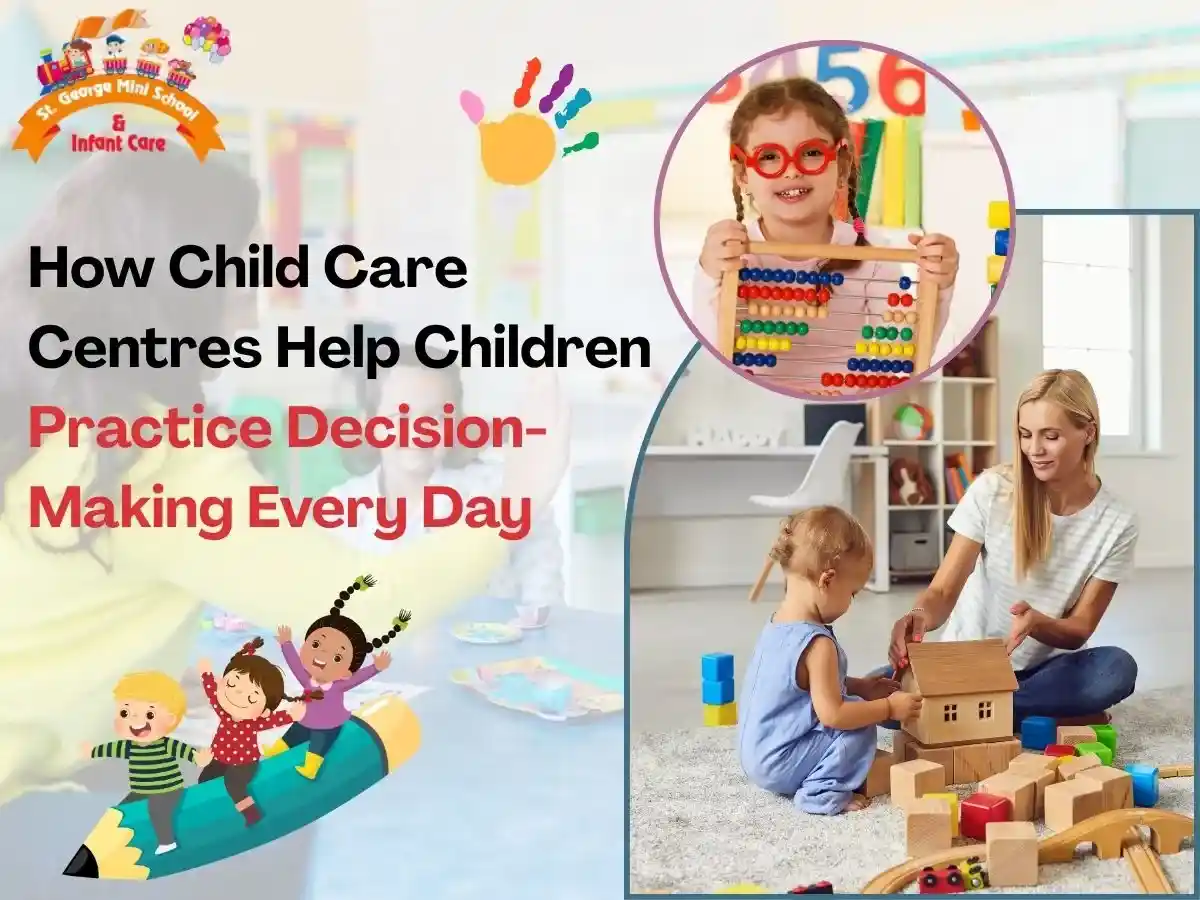
But that's exactly what it is. And it's one of the more overlooked things a good day care actually does — not because anyone's running a lesson on choices, but because the whole structure of the day is quietly built to give children real ones.
What "Decision-Making" Actually Requires From a Three-Year-Old
Making a decision — even a small one, like which activity to try next — isn't a single skill. It draws on a set of cognitive abilities researchers group under the term executive function, which the Center on the Developing Child at Harvard describes with a useful comparison: it's the brain's version of air traffic control, managing multiple things at once so a person can act with intention instead of just reacting.
Executive function is generally broken into three core pieces. Working memory lets a child hold onto information long enough to use it — remembering that they were going to build a garage for their block tower, even after getting distracted twice. Inhibitory control is what lets a child stop themselves from grabbing a toy someone else is using, or wait their turn instead of acting on impulse. Cognitive flexibility is the ability to shift between ideas or approaches — trying a different way to fit two blocks together after the first way didn't work.
None of these are things a toddler or young preschooler has fully developed yet. They're being built, slowly, through exactly the kind of small daily choices a good classroom offers dozens of times a day.
Why Practice Matters More Than Instruction
Here's the part that surprises a lot of parents: you can't really teach decision-making the way you'd teach the alphabet. It's not something children absorb by being told about it — it develops through repeated, low-stakes practice, the same way a muscle develops through repeated use rather than through being told how to lift.
Research reviewing how executive function relates to decision-making across childhood has found a consistent pattern: these underlying cognitive skills play a stronger role in decision-making during early childhood than they do later on, when other factors like experience and social reasoning start to carry more weight. In other words, the early years are precisely when this kind of practice does the most work — which makes the structure of a child's day-to-day environment, including their time in child care, more developmentally significant than it might look from the outside.
There's longer-term evidence too. A large longitudinal study tracking children from kindergarten age into adolescence found that early self-regulatory behaviour — things like attentional control and how a child approached learning tasks at ages 4 to 7 — was directly linked to their executive functioning years later, at 14 to 15. Early practice doesn't just help with the immediate task. It appears to lay groundwork that shows up a decade later.
What This Actually Looks Like in a Real Classroom
A lot of this happens in moments too small to notice unless you're looking for them.
Free play periods where children choose their own activity, rather than moving through a single fixed task as a group, force a small decision right at the start: what do I want to do, and why? Snack and mealtimes where children are offered real choices — how much to take, which of two options to try — build the same muscle around a low-stakes, safe decision. Conflict moments, handled well, become decision points too: an educator who asks "what do you think you could do instead?" rather than immediately solving the problem for a child is handing a decision back to them, deliberately.
Even transitions can be structured this way. A room that gives a child a genuine choice — "do you want to clean up the blocks or the puzzles first?" — is offering a small, manageable decision inside a moment that could otherwise just be an instruction to follow.
None of this means chaos or a lack of structure. The most effective version of this actually depends on structure — clear routines and predictable boundaries are what make it safe for a young child to practice choosing, because the choices are bounded rather than overwhelming.
Why Not Every Program Actually Does This
This is where the difference between a good child care centre and an average one gets concrete, and it's not something you'd necessarily catch from a website.
A rigidly scheduled classroom — same activity, same order, same choices for every child, every day — can still be safe, warm, and well-run, but it isn't giving children much practice at this specific skill. Everything's already decided for them. On the other end, a completely unstructured room with no routine and no adult scaffolding isn't actually better; without some structure, young children don't have the tools yet to make good use of open-ended freedom, and it can tip into overwhelm rather than growth.
The programs that do this well tend to sit in the middle: predictable daily structure, with real, bounded choices built into it throughout the day — not a single "choice time" bolted onto an otherwise rigid schedule, but small decisions woven through arrival, play, meals, and transitions.
What to Ask When You're Touring a Day Care Center in
North York
A few questions get past the marketing
language and into what actually happens in the room:
Walk me through a typical morning —
where in that schedule do children make their own choices, versus follow a set
activity?
How do educators handle a disagreement
between two children — do they resolve it for them, or guide them toward
deciding themselves?
Is free play a real part of the day, and
how much of it is child-directed versus adult-led?
How do you balance structure and choice
for children who are still building self-regulation — what happens when a child
struggles with too much freedom?
A centre with specific, concrete answers
here is telling you something real about the philosophy behind the room, not
just the schedule posted on the wall.
Common Mistakes — By Both Centres and Parents
Offering
choices that aren't real choices. "Do you want
to clean up now, or in five minutes?" isn't actually optional if the
outcome's the same either way. Kids notice the difference between a genuine
choice and a disguised instruction faster than adults expect.
Too
much unstructured freedom, too soon.
Open-ended choice without any scaffolding can overwhelm children who don't yet
have the self-regulation to manage it — decision-making practice works best
within clear, predictable boundaries, not the absence of them.
Solving
every conflict for the child. Stepping in
immediately to fix a disagreement feels efficient, but it removes the exact
moment where a child would otherwise practice negotiating, waiting, or choosing
a different approach.
Assuming
this only applies to "big" decisions.
The actual research points the other way — it's the accumulation of small,
repeated, low-stakes choices that builds the skill, not the occasional big one.
At St. George Mini School, daily
routines across all three North York locations are built around real, age-appropriate
choices — not just a fixed schedule everyone follows the same way. Book a tour
to see how a day care center in north
york can actually build decision-making into everyday moments.
Featured Blogs
 28/03/22
Which Is The Best Age To Start Chil...
Daycare North York Infant Daycare North York Day Care Center North York Subsidized Daycare North York Daycare Toddlers North York Preschool Programs North York Child Care North York Before and After School Care North York Day Care North York Preschool North York Subsidized Child Care North York Day Care Schools North York





33 Mallard Rd. Centre
- Contact: Sarah Ashfield
- Tel: (647) 478-6114
- E-mail: [email protected]
- 33 Mallard Rd., North York, Ontario M3B 1S4
25 Mallard Rd. Centre
- Contact: Rasha Shamas, RECE
- Tel: (647) 812-7795
- E-mail: [email protected]
- 25 Mallard Rd., North York, Ontario M3B 1S4
141 Bond Ave. Centre
- Contact: Jenna Wright, RECE
- Tel: (647) 478-6043
- E-mail: [email protected]
- 141 Bond Ave., North York, Ontario M3B 1M1
All Rights Reserved © 2026-2027. St. George Mini School & Infant Care.