 Waiting List Registration
 Book A Tour
33 Mallard Rd: (647) 478-6114
141 Bond Ave: (647) 478-6043
25 Mallard Rd: (647) 812-7795
33 Mallard Rd: (647) 478-6114
141 Bond Ave: (647) 478-6043
25 Mallard Rd: (647) 812-7795
2026-05-18
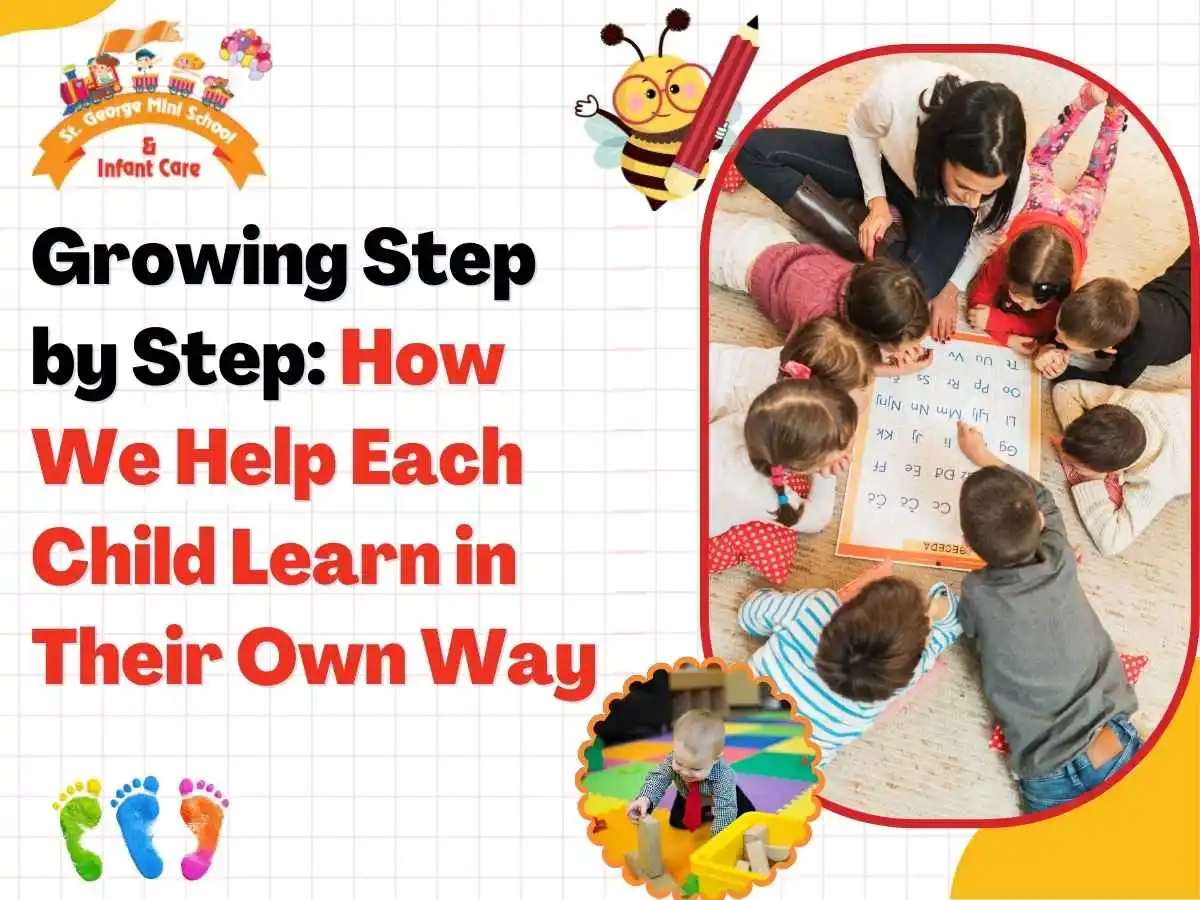
No two children are the same.
Every parent knows this — usually by the time their second child arrives and
completely defies every expectation set by their first.
One child talks in full sentences
at two. Another waits until three and then suddenly begins speaking in full
paragraphs. One child races toward every new experience. Another watches
carefully from the sidelines until they're absolutely ready. One child learns
best with their hands in paint, or sand, or dough. Another learns best through
stories and conversation.
None of these children is falling
behind, and none is ahead of where they should be. They're all just themselves
— developing at their own pace, in their own way, along their own remarkable
path.
At St. George Mini School, a
child care provider rooted in North York for years, this isn't just something
we say. It's the foundation everything else is built on.
Why "One Size Fits All" Doesn't Fit
Early Childhood
The early years — roughly birth
to age six — represent the most rapid period of brain development in a human
lifetime. During this window, children are building the neural pathways that
will shape how they learn, relate, regulate their emotions, and engage with the
world for decades to come.
What developmental science makes
clear is that this growth doesn't happen on a single timeline. It happens
across multiple domains — cognitive, physical, social, emotional, and
linguistic — and each domain develops at its own rate, shaped by each child's
temperament, environment, experiences, and biology.
A daycare or day care center that
treats every child as if they're at the same point, moving toward the same next
step, misses the whole picture. Worse, it can leave a child feeling incapable
of meeting expectations that simply weren't designed with them in mind.
Quality child care does the
opposite. It starts with the child — who they actually are, not who the
calendar says they should be.
What Individualized Learning Actually Looks
Like in a Day Care Setting
It's a phrase that gets used a
lot in early childhood education. But what does individualized learning
genuinely look like inside a daycare classroom on an ordinary Tuesday?
It looks like an educator
noticing that one child understands new concepts better after observing others
first — and quietly ensuring that child gets the time they need without being
rushed.
It looks like offering the same
activity in three different ways: with blocks for the child who thinks
spatially, with a story for the child who connects through narrative, and with
a hands-on experiment for the child who needs to do before they can understand.
It looks like a caregiver who
knows that a particular child's meltdown before lunch isn't defiance — it's
hunger and overstimulation — and adjusts the afternoon rhythm accordingly.
“It means avoiding phrases like,
‘You should be able to do this by now.’” — because that sentence has no place
in a child care environment that truly understands development.
At St. George Mini School, our
educators are trained to observe before they intervene, to follow before they
lead, and to meet each child exactly where they are.
The Role of Observation in Child-Centered
Care
The most important tool in a
developmentally informed daycare isn't a curriculum binder. It's a thoughtful,
consistent observation.
When educators pay genuine
attention — not just to what a child can do, but to how they engage, what
lights them up, what shuts them down, where they engage deeply and where they
tend to withdraw — they build a portrait of that child that no standardized
checklist can capture.
This ongoing observation shapes
everything: how activities are offered, how transitions are handled, how a
caregiver speaks to a child during a difficult moment, how a room is arranged
to support different kinds of learners and different kinds of play.
At our day care center in North York,
documentation and observation aren't administrative tasks. They're how we get
to know your child — and how we make sure every decision we make is made with
that specific child in mind.
Growing at Their Own Pace Is Not the Same as
Growing Without Support
One thing worth saying clearly:
child-centred learning doesn't mean hands-off learning.
Meeting a child where they are
means knowing where they are with precision — and then offering exactly the
right amount of support to help them take the next step. Not too much, which
creates dependence. Not too little, which leaves a child stranded. The right
amount of support, at the right moment.
In the research on early
childhood development, this is called scaffolding — and it's the hallmark of a
skilled, attentive caregiver. It requires patience, expertise, and a genuine
relationship with each individual child.
This is what separates a great
daycare in North York from one that simply fills the hours.
Every Child Has a Step That's Theirs to Take
At St. George Mini School, we
don't measure children against each other. We measure each child against their
own last step — and we celebrate every single one.
Because growth isn't a race, it's
a journey that belongs entirely to the child making it. Our job is to make sure
they never have to make it alone.
If you're looking for child care
in North York that genuinely sees your child as an individual, we'd love to
show you what that looks like in practice.
[Book a Tour at St. George Mini School
→][Contact Us to Learn About Our Programs →]
St. George Mini School — where
every child's pace is the right pace.
Featured Blogs
 28/03/22
Which Is The Best Age To Start Chil...
Daycare North York Infant Daycare North York Day Care Center North York Subsidized Daycare North York Daycare Toddlers North York Preschool Programs North York Child Care North York Before and After School Care North York Day Care North York Preschool North York Subsidized Child Care North York Day Care Schools North York




33 Mallard Rd. Centre
- Contact: Sarah Ashfield
- Tel: (647) 478-6114
- E-mail: [email protected]
- 33 Mallard Rd., North York, Ontario M3B 1S4
25 Mallard Rd. Centre
- Contact: Rasha Shamas, RECE
- Tel: (647) 812-7795
- E-mail: [email protected]
- 25 Mallard Rd., North York, Ontario M3B 1S4
141 Bond Ave. Centre
- Contact: Jenna Wright, RECE
- Tel: (647) 478-6043
- E-mail: [email protected]
- 141 Bond Ave., North York, Ontario M3B 1M1
All Rights Reserved © 2026-2027. St. George Mini School & Infant Care.